
Calling your first Rueda & beyond
Shaun's tips and tricks for calling a Rueda de Casino with your friends

Hello! A question I often get asked is how I think about Ruedas and how I go about calling Ruedas. It’s something I always enjoy but also always something that makes me really happy to see other dancers do as well.
I’ll split my tips up into a beginner, intermediate and advanced tips! I’d say to work through the tips at your own level. Don’t worry about the advanced tips if you’re starting to call a Rueda for the first time — work through what feels comfortable and come back for more tips when you feel ready.
If you’re just starting out…
Call a move on the 1 , for the next 1.
This is the best way to do it when starting out and is a very helpful rule to stick to when calling a Rueda. Often times this is the clearest way to do it. For example, call Enchufa on 1, and then finish your Guapea, and watch the Enchufa start on the next 1.
Mistakes are part of it, don’t worry
You’re bound to make mistakes when learning to call Ruedas, don’t worry about them! When they do happen I recommend just smiling and laughing them off. Everyone is there to just have fun and dance, so they won’t care about your mistakes and nor should you.
Simple! Simple!
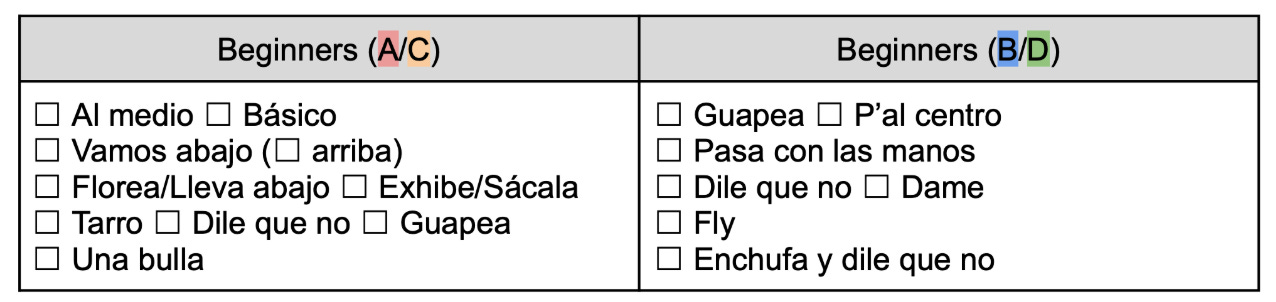
There are a couple moves that can really be your bedrock when it comes to calling. I’d recommend starting with beginner moves especially. When in doubt, call Enchufa or dame or fly!
Here are other basic moves you can think about when calling your Rueda
Use Fly to bring people back to the 1
Cuban music is complex, it’s why we love it. It’s common for people to lose track of the 1 — I usually fix this by calling for a Fly to ensure we’re all on the same page.
If this is your first time calling, I’d recommend trying those tips above before continuing to read the ones below as they might get in the way of your learning as caller.
Time to improve?
Hand signs are really helpful
for getting the message across to everyone. It’s not always easy to get your voice across a big room especially as your Ruedas grow larger and larger. Clear and consistent hand signs can go a long way to ensure everyone has the chance to execute the moves.
Sometimes, somethings don’t feel good to call on the 1
For moves that start on the 3 or 5, like una Vuelta, calling on the 1 doesn’t give people enough time to setup and lead the move. In these cases it can feel better to call on the 5 for the next 5. Sometimes calling on the 7 for the next 5 can feel good as well. I think this tip is just a matter of feeling it out the more you call but its good to know that this will be an option for you as the caller.
(Musicality) Start closed, move to open
Most Timba songs start with a smoother more romantic energy, before bursting out into a high energy Tumbao or Mambo. At these points of lower energy, I would suggest your dance to reflect the energy in the song as well. Do some nice walking as group (Vamos Abajo, Florea, Exhibe etc.) and when the energy starts picking up — call Dilequeno and move into Guapea , Dame and Enchufa.
If the energy goes back down in the middle of the song, I’d recommend moving back to closed position moves. The contrast of the dance between open and closed can be really beautiful to watch.
Match the experience of your group
It can feel great to always dance with your friends who already know all the moves. These are often the Ruedas I find the most fun because it gives me more creative opportunities to experiment with different combinations of moves. However, this won’t always be the case and often at parties there will be beginners that will want to join your Rueda! This is equally great news because it means your community is growing and it becomes really meaningful to create a welcoming Rueda for all.
At these moments I try to call things that are simple, fun, and easy to pick up. I don’t go more difficult than exhibe / enchufa for a spin. Other fun moves look like Ping-pong, Pati Pamí (Ni Pati ni Pa Mí), Sacude (shimmies), Fly or anything that gets people grooving. If people don’t know the spins, getting them dancing is meaningful enough.
If you want to maintain a high level Rueda at a party, it is also very acceptable to ask a beginner pair to join the next Rueda or sit this one out. Another good way to keep things together at a high level are to call difficult moves from the get go, for example Enrosca.
Loud and high pitched when calling
An interesting tip is of course to keep your voice audible at all times but also trying to say things in a higher pitch. The middle frequencies are very busy in cuban music with many many instruments, keeping your voice at a higher pitch when calling can help you cut through the music and reach everyone’s ears.

I’m like basically a pro
The song switched from 1 to 5??
You’ll find that in many cuban salsa / timba songs, that the 1 will suddenly switch to the 5. Usually happening around the middle of the song after a musical break or a change in feeling of the song. This can be interesting to deal with as a caller. With beginner crowds I often just stop the Rueda and get everyone back on the one.
A more interesting way I found to deal with it was to call Enchufa con Mambito, asking for a mambo with just two steps (1 & 3) instead of 4 steps (1,3,5,7) before returning to Dilequeno. This’ll switch you back to dancing on 1. This was something Or Gadish used to do often.
Presenting your energy
This is perhaps the hardest thing to work on. I’ve found the joy of a Rueda can be entirely made up of the person calling it and what they decide to bring to it. Obviously in complexity of calls but also purely in the sense of joy they have whilst doing it. It can be really hard to work on when you’re starting out but the more you do it and the more you listen to the music, the more I believe the joy you have dancing will transmit in the way you call and the way you dance.
Some quick tips would be to try not to look nor feel scared when you call, try your best to smile, and don’t worry if you make a mistake or a bad call. If you look worried, everyone will feel worried. If the mistake doesn’t bother you, it won’t bother anyone else. It can be easy to grimace when something goes wrong, try not to grimace.
Dance freely
If you’re the caller, and everyone around you appears comfortable with the moves you’re doing, that’s the point I like to implement my own liberties to the dance. These can be elements of musicality such as stepping on mambo during a Guapea, hitting musical breaks because you can, reacting differently to a fly while everyone claps.
I enjoy singing sometimes in my Ruedas, or adding onomatopoeia to contribute to the energy (Ahí Nama! Boom! A Hue!). Perhaps something that should be used sparingly since you are calling after all — I still spend time working through that till today.
Something Ryan (Mead) had mentioned to me previously, was that you can do 70 Complicado if you call 70. This means that while everyone does the regular 70, you can do the more complicated version of it. They both take the same amount of time and can be really fun to do as a challenge while dancing, just gotta make sure you’re dancing with a follower that would be comfortable following a different lead.
I wonder what other moves could I do a more complicated variation of..
Thanks for reading
I’ve spent a bunch of time calling Ruedas and developing my style when it comes to what I like to dance and see in Ruedas. I’ve found that moves that incorporate a lot of movement around the Rueda look a lot better than static long figures. Group moves like Patín are amazing, but even things like Pasa con las Manos, Botella y Tapa, or Estrella look beautiful when looking from outside in!
Another thing I’ve tried doing is reducing Guapea time when it comes to a Rueda, especially when it comes to advanced Ruedas. Something you could try in the future would be try treating Pasa con las Manos (PM) as your “base” move in a Rueda, and calling all the subsequent moves from there. For example,
(PM) —> (Adios) or
(PM) —> (Vacila y Dame) or
(PM) —> (Pasea) —> (PM) —> (Enchufa y Dame).
Musicality is also super fun to call in a Rueda, see how to call a Ponche here .
Anyways, those are all my tips for now! I’d be interested to hear about your experience calling. If you had any tips you’d like to share with me, I’d love to hear them.
Shaun
kualarueda.com